
Puberty is a natural part of development, and it is when a child goes through physical, hormonal, emotional and mental changes to reach sexual maturity. These changes begin and end at different ages for each child, depending on their sex, race, and ethnicity, as well as environmental factors.
Today, we’re going to discuss the five different Tanner stages of puberty for both boys and girls.
For clarity, a boy refers to a child with testicles and a girl refers to a child with ovaries.
What is Puberty?
Puberty is your body’s natural way of physically becoming an adult. During this time, your major organs and body systems mature, and your body becomes capable of sexual reproduction.
It’s a biological process driven by hormonal changes that affect physical growth, emotional development, and sexual maturity.
But even though the fact that puberty makes you physically an adult, your brain continues to develop and mature into your mid-to-late 20s.
In Short, What Happens During Puberty?
During puberty, a child’s body changes into an adult body. Their brain activates the Hypothalamic-Pituitary-Gonadal (HPG) axis, which then tells the body to produce sex hormones, like testosterone in boys and estrogen in girls.
After this, a child will go through a growth spurt, both in length and body size, their reproductive system will mature (girls will get their period, and sperm production starts in boys), secondary sexual characteristics develop (such as breasts, a deeper voice, and body hair), and there may be noticeable emotional and mood changes.
In more detail, when it comes to puberty, there is something called the five Tanner stages. These are different for both girls and boys.
What Are the Five Tanner Stages in Boys?
Firstly, when does puberty usually begin in boys? Around ages 9-14, with full development typically completed by 16-18. This can vary though.
Stage 1: Prepubertal
At stage one, there are no visible signs of puberty yet, and the testicles, penis, and body hair are still childlike.
Stage 2: Early Puberty
At stage two, the testicles and scrotum begin to enlarge, the skin of the scrotum will start to thin and redden, and sparse, fine pubic hair will begin to grow at the base of the penis.
Stage 3: Mid Puberty
At stage three, the penis starts to lengthen, the testicles continue to grow, pubic hair becomes darker, coarser, and curlier, there may be early voice changes, and a growth spurt often starts.
Stage 4: Late Puberty
At stage four, the penis grows in both length and thickness, the scrotum and testicles are larger and darker, adult-type pubic hair is present, there is a noticeable deepening of the voice, and acne and body odour may start to appear.
Stage 5: Full Maturity
At stage five, the genitals reach adult size and shape, pubic hair spreads to the inner thighs, facial and chest hair may develop, the voice is fully deepened, and growth slows and eventually stops.
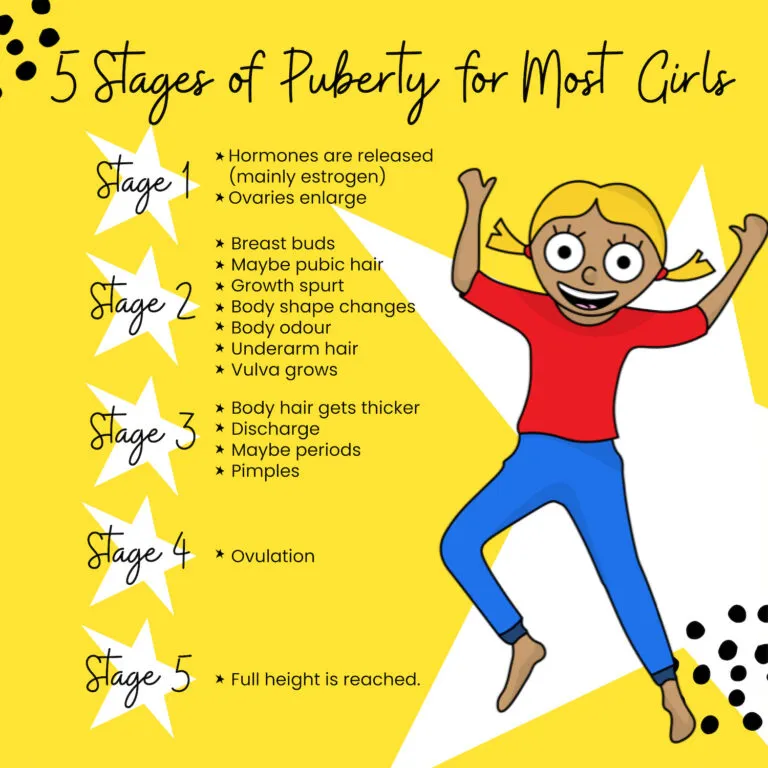
What Are the Five Tanner Stages in Girls?
When does puberty usually begin in girls? Around ages 8-13, with full development typically completed by 15-17. This can vary though.
Stage 1: Prepubertal
At stage one, there is no breast development or pubic hair yet, and the ovaries and reproductive system are still immature.
Stage 2: Early Puberty
At stage two, breast buds appear (small, tender lumps under the nipples), the areola (the area around the nipple) begins to widen, and fine, soft pubic hair begins to grow.
Stage 3: Mid Puberty
At stage three, the breasts grow larger and begin to take shape, pubic hair becomes darker, coarser, and curlier, growth spurts often begin, and vaginal discharge may start.
Stage 4: Late Puberty
At stage four, the breasts are more developed, with the nipple and areola forming a raised mound, pubic hair is adult-like in texture, and menstruation usually begins.
Stage 5: Full Maturity
At stage five, the breasts reach their adult size and shape, pubic hair spreads to the inner thighs, and the menstrual cycle becomes more regular over time.
How Long Does Puberty Take?
Puberty usually takes about 3 to 5 years from the first physical signs to full adult development, but this can vary from person to person. In fact, starting earlier or later can still be completely normal.
Important to remember though: growth and emotional development can continue after physical changes end.
What Affects the Timing of Puberty?
There are a lot of things that can influence the timing of puberty. Things such as one’s biology, environment, and lifestyle play a big part, and for that reason, there’s not one single factor that controls it.
Here are the main things that affect when puberty starts and how quickly it progresses:
Genetics
Your genes actually play the biggest role. If one’s parents (especially the mother) started puberty early or late, the chances that their child will follow the same pattern are high. Specific genes influence when the brain signals the body to begin puberty.
Nutrition & Weight
With the right and adequate nutrition, the body can reach the energy level needed to begin puberty. Undernutrition or an eating disorder however can delay puberty, as a severely low calorie intake may slow down development. If there are higher fat levels in girls, it may result in an early start of puberty.
Hormones
Puberty will start when the brain, more specifically the hypothalamus and the pituitary gland, activates the reproductive system. If a child has any conditions that affect hormone production, such as a thyroid disorder or pituitary issues, this can speed up or delay puberty.
Stress & Emotional Environment
For some, early puberty is linked to those who face early life stress, early-life adversity.
Physical Environment
Those who have been exposed to endocrine-disrupting chemicals that are found in some plastics or pesticides may start puberty earlier.
Physical Activity
Some forms of high intensity training can delay puberty, especially in girls. Some activities include sports that emphasise low body weight, like gymnastics, ballet, or long distance running.
What is Considered Early or Late Puberty?
- Early puberty in girls is before age 8 in girls, and age 9 in boys.
- Late puberty in boys is if there are no signs at all by age 13 in girls and by age 14 in boys.
If you have a child who is experiencing unusually early or late puberty, consulting a pediatrician or an endocrinologist pediatric doctor is an excellent idea. An endocrinologist is a specialist who will be able to evaluate hormone levels, growth patterns and more.

Source link