
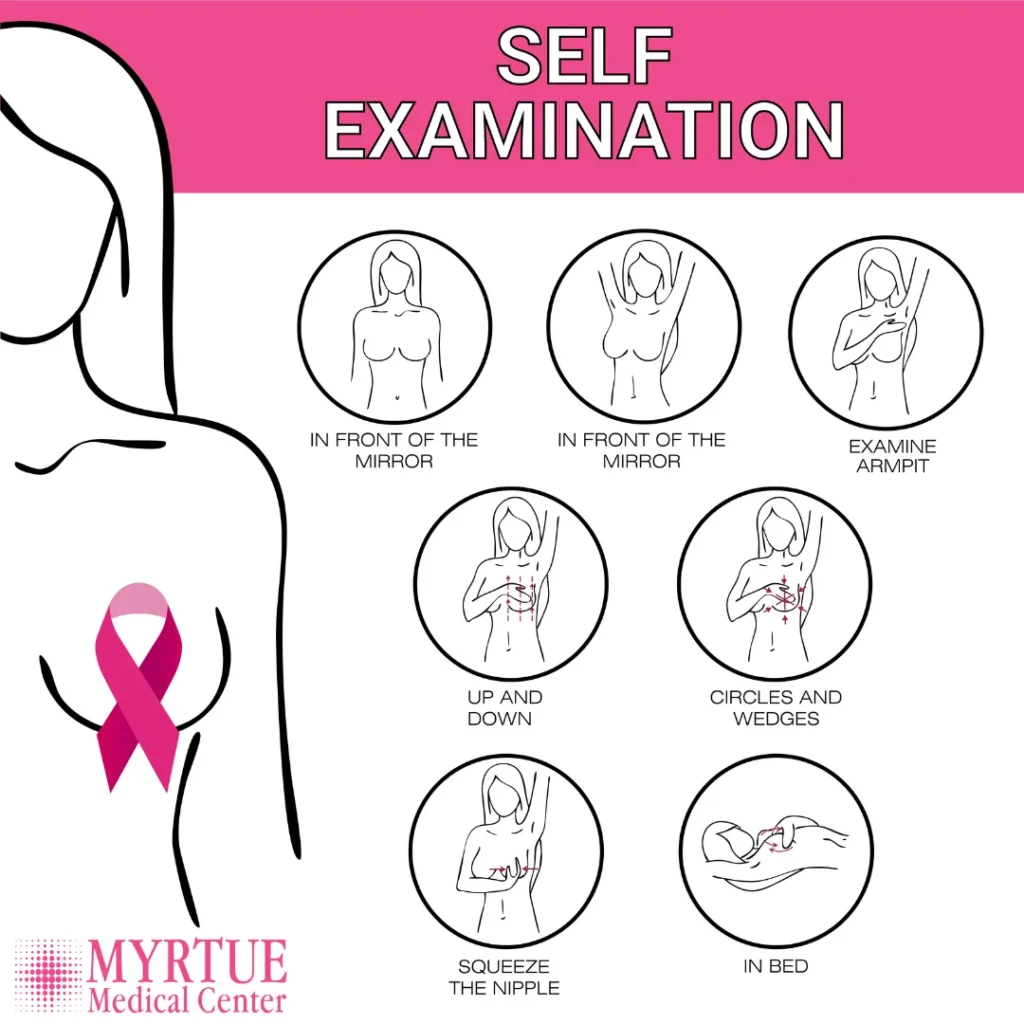
A breast self-exam is when you check your breasts, by sight and by touch, for any changes, like a new lump. And many professionals will agree that becoming familiar with what your breasts normally look and feel like is a great way in which to become aware of any changes for early concerns or cancer detection.
Today, we’re going to be looking at breast lumps, what it feels like, the different types, and how to check for breast lumps aka do a breast self-exam.
What Is a Breast Lump?
A breast lump is a localised swelling, bump, or mass in the breast that feels different from the surrounding breast tissue, and it can vary in size, texture, and tenderness.
And while it can be completely daunting, it’s important to remember that the majority of breast lumps are not breast cancer. In fact, there are many conditions that may cause benign (non-cancerous) breast lumps. On the other hand, the absence of a noticeable breast lump doesn’t mean that breast cancer cannot or hasn’t developed.
This is why it’s important for women to do self-exams monthly from the age of 18, and for women over the age of 40 to go for an annual mammogram.
What Does a Breast Lump Feel Like?
A breast lump can feel different depending on its cause. It can be found in or around the breast tissue, or in the underarm area, and its size can vary from a pea to larger than a golf ball. Some common sensations and textures include:
Firm or Hard
- This may feel like a solid mass within the breast
- Cancerous lumps are often hard and irregular
- Benign lumps can also feel firm
Smooth and Moveable
- Often round or oval
- Can move slightly under your fingers
- Is often common with fibroadenomas (non-cancerous growths)
Soft or Fluid-Filled
- May feel squishy or like a small water balloon
- Often tender before a menstrual period
- Common with breast cysts
Tender or Painful
Fixed in Place
- A lump that doesn’t move easily
The Different Types of Breast Lumps
For clarity, we’ll divide this up into two sections; benign and malignant. Benign means non-cancerous, and malignant means cancerous.
Benign Breast Lumps
- Fibroadenoma: occurs primarily in women in their 20s and 30s, the lump may feel rubbery and move around freely, it’s often painless, varying in size, and can form anywhere in the breast tissue.
- Fibrocystic breasts: may come about in women with dense breasts, occurs naturally due to hormonal fluctuations during menstruation, may feel lumpy, swollen, and sore before a period.
- Breast cyst: a fluid-filled sac inside the breast that’s round or oval and may feel soft or firm. They’re smooth, moveable, can be tender, and may change in size during menstruation.
- Fat necrosis: scar tissue from injured breast fat that may occur after trauma, surgery, or radiation. They’re a firm, round lump, sometimes causing skim dimpling, and may mimic cancer on imaging.
- Lipoma: a slow-growing, fatty lump mass made of fat cells that are soft, painless, and move easily under the skin.
- Breast abscess: an infection (pocket of pus due to a bacterial infection) that causes a painful lump, and is often associated with breastfeeding. Symptoms include redness, swelling, and a fever.
- Intraductal papilloma: a small wart-like growth inside a breast, near the nipple, that can lead to nipple discharge.
Malignant Breast Lumps
Cancerous breast lumps are caused by abnormal, uncontrolled cell growth in breast tissue. Unlike benign lumps, they can invade surrounding tissue and spread (metastasise) to other parts of the body.
Invasive ductal carcinoma (IDC): the most common type of breast cancer that begins in the milk ducts and spreads into surrounding breast tissue. Symptoms may include a hard, irregular lump, skin dimpling, and nipple inversion.
Invasive lobular carcinoma (ILC): the second most common type of breast cancer that starts in the milk-producing lobules and spreads into nearby tissue. Symptoms may include thickening instead of a distinct lump, fullness or swelling, and subtle breast shape changes.
Ductal Carcinoma in situ (DCIS): stage 0 breast cancer that’s abnormal cells confined to the milk ducts that haven’t invaded the surrounding tissue. Symptoms may include nipple discharge, but there is often no lump.
Inflammatory breast cancer: a rare but aggressive form of breast cancer of which the cancer cells block the lymph vessels in the skin of the breast. Symptoms may include a red, swollen breast, warmth, skin that looks like an orange peel, and often without the presence of a distinct lump.
Triple-negative breast cancer: hormone receptor-negative cancer, which is when there is a lack of estrogen receptors, progesterone receptors, and HER2 protein.
HER2-positive breast cancer: when there are high HER2 protein levels, promoting rapid growth.
Paget disease of the breast: a rare form of breast cancer affecting the nipple and often the areola. Symptoms may include red, flaky nipple skin, burning or itching, and a possible underlying lump.
How To Check for Breast Lumps At-Home
A simple, step-by-step guide on how to do a breast self-exam (BSE)…
1. Get in Front of a Mirror
Stand undressed from the waist up in front of a mirror with your arms relaxed. Take a look at your breasts for changes in size or shape, swelling, skin dimpling (like an orange peel), redness or a rash, nipple inversion, or unusual discharge. Then, raise your arms overhead and repeat. After, place your hands on your hips pressing firmly and repeat again.
2. Lie Down
Lie down and place a pillow under your right shoulder. Put your right arm behind your head. Use the pads of your three middle fingers on your left hand and choose one pattern:
Circular: small circles from outer breast towards the nipple
Vertical lines: up and down strips
Wedge pattern: from outer breast toward the nipple and back out
Use three types of pressure: light for just beneath the skin, medium for the middle tissue, and firm for the deep tissue near the ribs.
Cover the entire breast, armpit area, area to the collarbone, and down to the bra line.
Repeat on the other side.
When Should You Do a Breast Self-Exam?
If you are menstruating, 3-5 days after your period ends
If you aren’t menstruating, choose the same day each month
If you’re pregnant, breastfeeding, or postmenopausal, pick a consistent monthly date
With this information, it’s clear that knowing your breasts well is a great way to notice any changes or abnormalities early, if they occur. Taking the time to do a monthly breast self-exam is therefore important, and could just save your life.

Source link