The Trump administration says federal agents have “absolute immunity” from prosecution in Minneapolis. Department of Justice and Homeland Security officials have indicated that criminal investigations into the killings by immigration agents of Minneapolis protesters Renee Good and Alex Pretti are inappropriate, declaring that both were domestic terrorists.
The killing of Good and Pretti raises legal, tactical and policy questions regarding law enforcement practices by federal agents.
In December 2025, the Department of Homeland Security launched “Operation Metro Surge” to enforce immigration laws in Minneapolis. The operation is being conducted by federal agents with the U.S. Immigration and Customs Enforcement and the U.S. Customs and Border Protection. One of the stated goals of Metro Surge is to arrest the “worst of the worst criminal illegal aliens.”
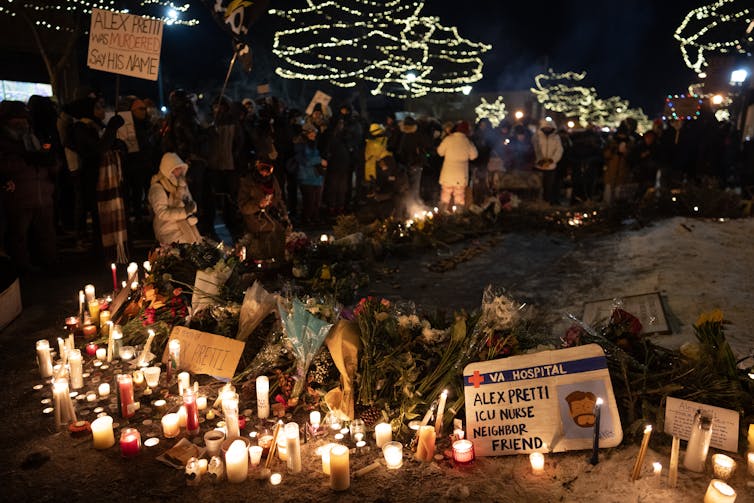
Metro Surge has also affected the lives of U.S. citizens, including citizens protesting immigration enforcement efforts. On Jan. 7, 2026, Good – a 37-year-old U.S. citizen and mother of three – was shot and killed in her vehicle by an ICE agent on a residential street in Minneapolis. On Jan. 24, 2026, CBP agents shot and killed 37-year-old Pretti, a U.S. citizen, on a public street in Minneapolis.
As a policing scholar and former FBI special agent, I believe these cases illustrate how some federal agents are engaging with the public in a way that undermines established principles of policing and constitutional law.
Law of deadly force
The Fourth Amendment to the U.S. Constitution protects the “right of the people to be secure in their persons … against unreasonable … seizures.” A law enforcement officer’s use of force – including deadly force – is considered in law to be a seizure and must be reasonable.
In the 1989 decision Graham v. Connor, the U.S. Supreme Court construed the objective “reasonableness” of force based upon “the perspective of a reasonable officer on the scene, rather than with the 20/20 vision of hindsight.” The court explained “reasonableness” in light of the idea that police officers must sometimes make “split-second” judgments.
In Tennessee v. Garner, the Supreme Court in 1985 established that the use of deadly force to prevent the escape of a fleeing suspect is unreasonable unless the suspect poses a significant threat of death or serious physical injury to the officer or others.
These legal principles form the basis of DHS deadly force policy, which is similar to the policy I followed as an FBI agent: Law enforcement officers, or LEOs, “may use deadly force only when the LEO has a reasonable belief that the subject of such force poses an imminent threat of death or serious bodily injury to the LEO or to another person.”
The legal question raised by the Good and Pretti killings is whether the officers had a reasonable belief that Good and Pretti posed an imminent threat of death or serious bodily injury to the officers.
Moments before the ICE agent killed Good, the agent walked around Good’s parked vehicle filming Good with his phone in one hand. Good, sitting behind the wheel in her car, says “That’s fine dude, I’m not mad at you.”
As the shooting agent positions himself in front of Good’s vehicle, a second agent walks quickly toward Good’s vehicle and tries to open the door and reach inside. Good turns her steering wheel and tries to drive away – what a law enforcement agent could interpret as potentially an act of fleeing. The agent in front of Good’s vehicle shoots Good three times as she drives by him. He then mutters, “f-cking b-tch,” and walks away from Good’s crashed vehicle. There is dispute about whether Good’s vehicle grazed the agent.
Moments before Pretti was killed by federal agents, he was standing in a public street when agents approached him and sprayed him with a chemical agent. Pretti’s hands are visible and show that he is holding a cellphone.
The agents wrestle Pretti to the ground and repeatedly beat him with an object. Pretti is not seen brandishing a firearm. However, an agent approaches Pretti during the scuffle and appears to remove a firearm from Pretti’s waistband. Shortly thereafter, agents shoot Pretti 10 times. Pretti had kicked the taillight of a law enforcement vehicle – and was then tackled and tear-gassed by agents – 11 days before he was killed.
Some former federal prosecutors argue that these facts in the Good and Pretti cases warrant a thorough criminal investigation regarding whether federal agents illegally used lethal force in the killings. The central legal question is whether the evidence shows that the agents reasonably feared for their lives, or whether they acted unlawfully out of anger, frustration, retaliation or some other unjustified mental state.
Tactics, policy and split-second decisions
Beyond legal questions, Operation Metro Surge raises tactical and policy questions about DHS law enforcement practices.
State, local and federal law enforcement officers are required to follow firearms safety rules. While training at the FBI Academy at Quantico, I was required to learn and follow the cardinal safety rules, which include (1) treating all firearms as loaded, (2) keeping firearms pointed in a safe direction and (3) keeping one’s finger off the trigger until one is ready to press it.
These rules help keep officers and the public safe, including by preventing unintentional discharges of firearms.
There were multiple bystanders and officers in the immediate vicinity of both the Good and the Pretti shootings. That raised risks associated with unintentional discharges and jeopardizing officers’ ability to meet the requirement to respect human life.
DHS officers specifically are also required to “employ tactics and techniques that effectively bring an incident under control while promoting the safety of LEOs and the public,” which includes avoiding “intentionally and unreasonably placing themselves in positions in which they have no alternative to using deadly force.”
In both the Good and the Pretti cases, federal agents placed themselves in poor tactical positions that increased the likelihood of using deadly force.
When feasible, DHS agents are required to issue a verbal warning to comply with the agent’s instructions. Agents rushed to physically remove Good from her vehicle and similarly rushed to push Pretti off the street and then spray him with a chemical agent. There is reason to think the agents could have taken a more measured, composed and communicative approach to de-escalate the situation.
These tactical and policy principles reveal that the legal analysis of an agent’s “split-second” decision to use deadly force is not the only issue raised by these cases. Analysis of the seconds and minutes leading to the use of force is also crucial.
Jeff Wheeler/The Minnesota Star Tribune
Warriors in the community
ICE and CBP federal agents are not police officers. However, they are law enforcement officers engaged in policing. Operation Metro Surge has made these agents highly visible.
Instead of the more traditional, methodical and long-term investigations they normally conduct, federal agents are now routinely taking on more of a traditional police role in the public eye. This role ranges from managing traffic violations to maintaining order during chaotic public protests.
Although the surge has brought these agents closer to a traditional police role, they are pursuing a militarized warrior model of policing.
Masked federal agents in tactical gear roaming the streets of Minneapolis blur the line between civilian and military policing. Coupled with events such as the killings of Good and Pretti, it is unsurprising that public trust is eroding not only in federal law enforcement agencies such as ICE but also in police departments generally.
Policing is difficult work under any circumstance. If federal agents continue to increase their interactions with the public, I believe they will need to embrace tactics from community policing and what is called procedurally just models of policing. These models emphasize building popular legitimacy by reinforcing relationships – through honest cooperation and partnership between law enforcement officers and the public.
The rule of law
Publicly available facts and evidence raise significant questions about whether federal agents acted contrary to established principles of policing and constitutional law in the deaths of Good and Pretti.
The rule of law is a cornerstone of liberal democracies that limits the exercise of discretionary or arbitrary power by government officials. This idea includes holding officials accountable when there is evidence of unauthorized uses of power. A thorough investigation into DHS tactics, I believe, is necessary to preserve the rule of law.

Source link