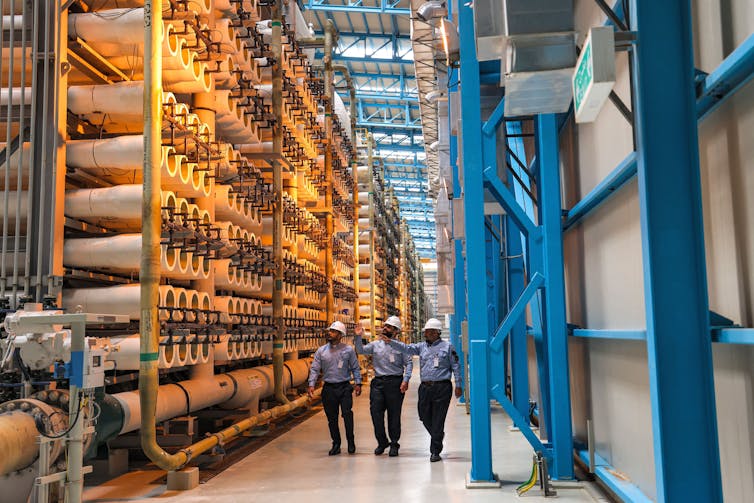
Saudi Arabia, the United Arab Emirates and neighboring countries in the Persian Gulf region use the fossil fuels under their desert lands not only to make money, but also to make drinking water. The petroleum they produce powers more than 400 desalination plants, which turn seawater into drinkable water.
In the war that began on Feb. 28, 2026, with U.S. and Israeli attacks on Iran, retaliatory attacks from Iranian forces have hit oil refineries and natural gas plants and disrupted tourism and aviation. Those attacks all hurt Gulf nations’ economies and their hard-won reputations for safety and stability.
But Iranian strikes have also already hit close to a key desalination plant in Dubai. Iranian strikes on March 2 on Dubai’s Jebel Ali port hit about 12 miles (20 kilometers) away from a massive complex with 43 desalination units that are key to the city’s production of more than 160 billion gallons of water each year.
And there has already been damage to the UAE’s Fujairah F1 power and water plant and at Kuwait’s Doha West plant. In both cases, the damage seems to have stemmed from attacks on nearby ports or from falling debris from drone interceptions.
Fayez Nureldine/AFP via Getty Images
Saltwater kingdoms
The region’s monarchies are often described as petro-states, but they have also become what I call saltwater kingdoms, global superpowers in the production of human-made fresh water drawn from the sea. Desalination is part of the reason there are golf courses, fountains, water parks and even indoor ski slopes with manufactured snow.
All together, eight of the 10 largest desalination plants in the world are in the Arabian Peninsula. Israel’s two Sorek plants round out the list.
The countries of the Arabian Peninsula have about 60% of global water-desalination capacity. And plants close to Iran, around the Persian Gulf and the Arabian Sea, produce more than 30% of the world’s desalinated water.
Roughly 100 million people in the Gulf region rely on desalination plants for their water. Without them, almost nobody would be able to live in Kuwait, Qatar and the UAE – or much of Saudi Arabia, including its capital, Riyadh.

Karim Sahib/AFP via Getty Images
Sabotage of water supplies
CIA worries about attacks on Gulf region desalination plants date back to the 1980s. During Saddam Hussein’s 1990 invasion of Kuwait, those worries became real.
After coalition forces began bombing Iraqi positions in January 1991, part of Iraqi troops’ response was to release millions of barrels of crude oil into the Persian Gulf. As the massive oil slick drifted south, U.S. and Saudi officials feared it was meant to sabotage desalination systems.
Workers installed protective booms to shield intake valves at major plants, especially the one that supplies much of Riyadh’s water. In Kuwait, Iraqi sabotage damaged or destroyed much of the country’s desalination capacity.
Kuwaiti authorities also turned to Turkey and Saudi Arabia to supply some 750 water tankers and 200 trucks to import an 18-ton emergency supply of bottled water. U.S.-supplied generators and mobile desalination units provided additional temporary relief, though the full recovery took years.

Chris Lefkow/AFP via Getty Images
More recent threats
Fears of attacks on desalination plants resurfaced after Yemen’s Houthi movement launched drones and missiles at Saudi facilities at Al-Shuqaiq in 2019 and 2022 – though they did no lasting damage.
Iran’s weapons are far more numerous and sophisticated than the Houthis’, though, so if it attacked desalination plants, the damage could be significant.
There is an irony here: Iran’s capital city of Tehran has a water shortage crisis so serious that in 2025 the government reportedly considered relocating the drought-stricken capital to the coast. But Iran is less vulnerable to attacks on desalination, because its water supply relies instead on dams and wells.
Whatever else the war may be about, water could well become a major factor in the violence and leave lasting political scars. And if either side were to intentionally attack water sources or desalination plants, it would clearly be a human-rights violation.

Source link