How conspiracies spread has changed immensely over the history of the United States, as technology and media have evolved. But the nature of conspiracies has not.
I teach communications courses at Villanova University, 12 miles from Philadelphia, on how conspiracy theories are created and disseminated.
As the nation approaches its 250th anniversary on July 4, 2026, I have been thinking about the early history of Philadelphia and the controversial people, stories and ideas, including conspiracies, that permeated the city during the second half of the 1700s.
Conspiracy theories describe alternative versions of events – such as the collapse of the twin towers of the World Trade Center on Sept. 11, 2001 – that contrast with the official, accepted versions of events. Conspiracies, however, involve small groups of people who act in secret for their own gain and against the common good. Examples of conspiracies include the Watergate scandal by President Richard Nixon and members of his administration, or the Tuskegee experiments in which U.S. public health professionals treated unsuspecting African Americans with syphilis with a placebo.
Colonial America was rife with perceived conspiratorial agendas. Many of these stemmed from the uneasy coexistence of political parties with religion – which was newly protected by the First Amendment – and with the Catholic Church in particular.
API/Gamma-Rapho via Getty Images
Freemasons in the cradle of liberty
Philadelphia was the country’s political center during the American Revolution, which began in 1775.
After the war ended in American victory in 1781, Philadelphia served as the capital of the U.S. beginning in 1790, until Washington, D.C., was chosen as America’s permanent capital in 1800.
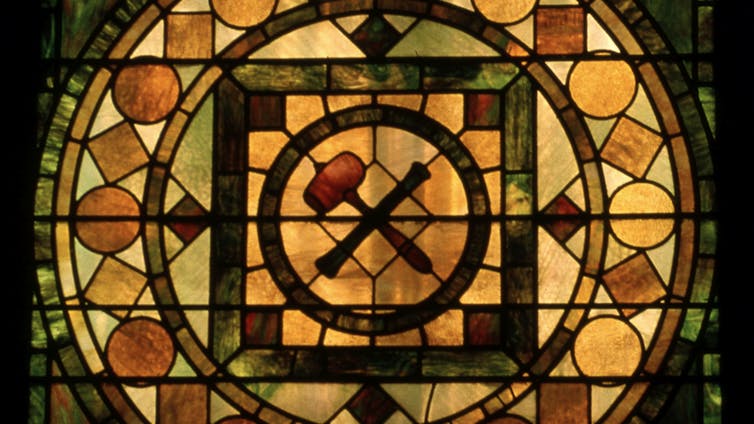
During this period, the U.S. depended on contributions from its political and civic figures to develop future leaders with skills and intelligence. Among this group and some of the country’s leaders were Freemasons, the independent “brethren” of skilled stonemasons.
In England, landowners or even royalty owned many masons, but some masons were self-sufficient and enjoyed their freedom to work as they wished. When they made their way to America by the 1720s, their high standards of workmanship, fair trade and reason as they taught their craft made them influential in society.
Being a Freemason was a mark of sophistication. Freemasons were high-status, wealthy men. The fraternity provided a forum for networking – not just for stone shapers but other men who were successful in business, trade or even Colonial administration.
By the late 1740s, almost all of Philadelphia’s Freemasons were also merchants, shipowners or successful artisans. They were considered political, intellectual and creative leaders in Colonial Philadelphia.

Albert Moerk/Library of Congress
Freemasons built notable structures throughout the Philadelphia and southern New Jersey areas as well as in New York, Boston and other parts of New England.
But because the group’s rituals and oaths were shielded from public view and performed in clandestine sessions in Masonic temples, rumors spread about their activities. Some people believed Freemasons secretly conspired against American values – especially religion.
Freemasons believed in principles such as rationalism, which views science and logic – rather than sensory experiences – as the foundations of knowledge. Freemasons also held that everything in the universe is the result of natural causes rather than the supernatural or divine.
They treated all religions equally. They allowed participation in them but believed no faith was to be favored as possessing the one true God. This was in contrast with religions that argued their doctrine exclusively expressed the truth. In 1738, Pope Clement XII banned Freemasons from joining the Catholic Church, a prohibition that still exists today.

Strobridge & Co. Lith./Library of Congress via AP
The ‘godless’ Illuminati
“Another “secret society” also peaked at this time in various parts of Europe, and it drew suspicion among Americans that members exerted influence over the new nation.
Members of the Illuminati, a movement that started in Germany in 1776, promoted Enlightenment values and ideas, including logic, secularism and education. Like Freemasons, they rejected superstition. Unlike Freemasons, however, they also rejected religion and its influence on society.
Europe mostly outlawed the movement before 1790 due to the group’s attempts to greatly lessen religious influence. The Illuminati occupied key roles in the educational system and government of Bavaria, where they weakened clerical authority.
The normally secretive Illuminati attracted attention through their attempts to attend and participate within Masonic temples. They used Freemason ideas along with their own ideas to recruit followers through these networks, hoping to promote an even stronger “one-world” government led by reason instead of religion and spiritualism.
As a result, religious – and specifically Catholic – leaders suspected an association between the philosophically consistent Illuminati and Freemasons.
In a letter to George Washington in 1798, Rev. G. W. Snyder from Maryland attempted to awaken Washington to the danger of the Illuminati and their influence on Freemasons. He wrote about a recently published book by the Scottish physicist John Robison called “Proofs of a Conspiracy” that, according to Snyder, “gives a full Account of a Society of Freemasons, that distinguishes itself by the name ‘of Illuminati,’ whose Plan is to overturn all Government and all Religion, even natural; and who endeavour to eradicate every Idea of a Supreme Being.”
Even today, conspiracy theories still promote the Illuminati’s existence, even after they were formally outlawed in Europe. Such theories suggest the Illuminati still work to degrade religious influence through civil upheaval. A myth survives that the Illuminati still operate secretly, support a world government and guide various governments on how to economically control the world.
But the Illuminati in the late 1700s seemed to dovetail with what people assumed were the basic ideas and agenda of Freemasons in America. Some in America suspected without obvious evidence that Freemasons used their status to boost fellow Freemasons to various governmental positions. They worried this would drive America to become godless, or even Satanic.
Concerns about the influence of Freemasons persisted in part because American presidents Washington and James Monroe were Freemasons. The American public was suspicious that these members reached high levels of government due to the influence of Freemasons. In fact, as many as 25 of the 55 men who attended the 1787 Constitutional Convention in Philadelphia were Freemasons. Founding father Benjamin Franklin was a devout Freemason for over 50 years. Thomas Jefferson was widely thought to be a Freemason, though there is little evidence to support this.
Many of these American leaders, including Franklin, John Adams and Jefferson, had spent time in Europe, especially France, during the late 1700s. Americans feared that European Illuminati members could directly access these political leaders and gain power and influence over the U.S. None of the leaders admitted to having any connection with the Illuminati.

SEN LI/Moment Collection via Getty Images
Conspiracy fears climax
Fears around the Freemasons and Illuminati came to a head in the dramatic and vitriolic U.S. presidential elections of 1796 and 1800.
In the 1796 election, Jefferson’s Republican Party accused Adams of wanting to be a king and also grooming his son, John Quincy Adams, to become president immediately after his father.
Adams’ Federalist Party and an anonymous writer in newspapers – suspected to be Alexander Hamilton writing under the pseudonym “Phocion” – spread rumors attacking Jefferson. Phocion suggested that while Jefferson was U.S. secretary of state in France during Washington’s presidency, the Illuminati influenced him in ways that would cause him to turn his back on religion.
Phocion also accused Jefferson of fathering children with an enslaved woman, Sally Hemings, whom he “kept as a concubine” when he returned with her from France in 1789. Historians believe Jefferson did, in fact, have up to six children with Hemings. The accusations also said Jefferson would free all enslaved people in America if elected.
Adams won in 1796 by just three electoral votes, but Jefferson defeated him in 1800.
Freemasons today
Freemasons today have largely shrunk from their once quite prestigious influence in American society. Today they are a mostly philanthropic organization that supports many causes, such as children’s hospitals, homes for the aged and community services.
There are about 1 million members in America, according to an estimate from 2020. That’s down from a high of over 4 million in 1959.
Relics of the era

K. Ciappa for Visit Philadelphia®, CC BY-NC-ND
Visitors to Philadelphia might consider two stops where they can be reminded of the conspiracy theories that circulated 250 years ago.
A marker at 175 Front St. notes where Tun Tavern, one of America’s first brew houses, stood from 1691 until it burned down in 1781. It was a hangout for Freemasons, including Franklin and other famous patrons such as John Adams.
Most of the Masonic lodges the city constructed early in its history do not exist today. The first Masonic temple built in Philadelphia was erected in 1809 on Chestnut Street, between 7th and 8th streets, but burned down in 1819.
The current grand lodge for all of Pennsylvania was built in 1873. It faces City Hall and remains a major Masonic base today. The site is very popular among tourists and offers hourly tours Wednesday to Saturday, 10 a.m. to 3 p.m.
Read more of our stories about Philadelphia and Pennsylvania, or sign up for our Philadelphia newsletter on Substack.

Source link