
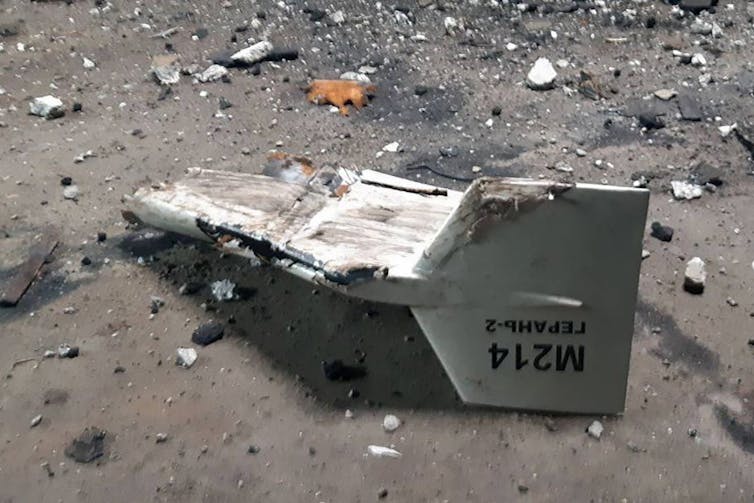
It may sound hard to believe, but the almost trillion-dollar U.S. military is struggling to fight cheap drones in its war with Iran.
Iran has built a simple drone, the Shahed, with a motorcycle-type engine, loaded it with explosives and successfully targeted its neighbors’ cities and power plants.
Iran has also hit U.S. military bases with these drones, including an early April 2026 attack on the U.S. Victory Base Complex in Baghdad.
The drones cost between US$20,000 and $50,000 to build. In response, the U.S. military sometimes fires missiles worth more than $1 million to shoot one down.
As a former U.S. Air Force officer and now national security scholar, I believe that math is a problem: The U.S. military for now has a $1 million answer to a $20,000 question. This math tells you almost everything you need to know about one of America’s biggest national security headaches.
And the frustrating part is that the U.S. military watched this happen in Ukraine for years. It knew the threat was coming.
The weapon that changed modern war
The Shahed isn’t impressive because it’s high-tech. It’s impressive because it isn’t.
Inspection of captured Shahed drones has found that many of their parts are made by ordinary commercial companies. That includes processors from a U.S. manufacturer, fuel pumps from a U.K. company and converters from China.
These military components aren’t hard to get. You could find similar parts in factories or farm machinery. That’s exactly what makes the Shahed so tough to deal with.
Russia, which also produces the drone, tolerates losing more than 75% of its Shahed stock because even at those loss rates, it’s winning the math battle against Ukraine. Russia or Iran don’t need every drone to hit its target. They just need to keep sending waves of them until their opponent runs out of expensive missiles to shoot back.
Ukraine, which had no choice but to learn fast, eventually figured out a better answer. Ukraine developed cheap interceptor drones that could slam into Shahed drones before they reached their targets. Each interceptor costs about $1,000 to $2,000, and Ukrainian manufacturers are producing thousands of them per month. That’s better math: a $2,000 interceptor against a $20,000 attacker.

Ukrainian military’s Strategic Communications Directorate via AP
Ukraine’s battlefield experience, as a result, has become one of the most valuable resources in the world, with American and allied forces asking Ukrainian drone experts to share their knowledge.
Why can’t the U.S. churn out a solution of its own? Because the U.S. military doesn’t have a technology problem but a bureaucracy problem.
The Pentagon’s three-legged slowdown
The U.S. Department of Defense typically can’t just buy things. It follows a long, complicated process that can take a decade or more to go from “we need something” to “here it is.” That process runs through three separate bureaucratic systems, each of which can cause years of delay.
First, someone must write a formal document, known as a requirement, that explains exactly what they need and why. A military service, such as the Air Force, for example, drafts up a requirement and routes it through an internal service review within only their branch.
Until recently, this service-vetted requirement went through a Pentagon review process, the Joint Capabilities Integration and Development System, where all joint services took a look. This process, which the Department of Defense ended in 2025, required approval from military officials.
Even though the joint requirements process was ended, implementation of a new system is far from complete, and the existing culture potentially remains. Under the old requirements process, it took over 800 days to get a requirement approved.
Second, any new program then needs money. This is handled through the planning, programming, budgeting and execution process, a budget cycle designed in 1961. Getting a new program into the budget typically takes more than two years after the requirement is approved, because the military must submit its budget request years in advance. By then, the threat has potentially already moved on.
Third, once a requirement is approved and money allocated, the program then must be developed and built. The average major defense acquisition program now takes almost 12 years from program start just to deliver an initial capability to troops in the field, according to a 2025 Government Accountability Office report.
Add it up and you get a system where the military sees a threat, begs for a solution, argues for money and waits a decade.
Why the system is built this way
The Shahed drone exposed a gap that defense experts have been warning about for years: The U.S. military is very good at building the most advanced, most expensive weapons in the world, but it struggles to build cheap, simple things fast. That is the opposite of what this new kind of warfare demands.
It would be easy, but inaccurate, to blame the military for the decade-long contract process. The real answer is more complicated.

Tom Brenner for The Washington Post via Getty Images
The Pentagon’s lengthy process was designed by the Department of Defense and Congress for a reason. Policymakers created the current system during the Cold War to combat excessive and redundant spending by the separate service branches. The system is built with checkpoints, reviews and approvals to make sure taxpayer money isn’t wasted.
Legacy military contractors also benefit from this dysfunctional process and resist change. They have the capital and know-how to wait out the predictable and stable existing contracts, while vying for new ones. These military contractors rarely need to worry about upstart contractors because they know small companies cannot survive waiting for a decade to secure funding for their prototypes.
The problem is that those rules were built for a world where the biggest threat was another superpower’s expensive jets and missiles. It wasn’t built to fight a flying bomb made from tractor parts. This type of threat requires fast innovation from lean companies, the exact companies that struggle in the current budget process.
What’s changing
There are signs of movement. In August 2025, the Pentagon killed its old requirements process entirely and replaced it with a faster, more flexible system.
However, killing the requirements process dealt with only one leg of the three-legged monster. The 1960s-era budget process that determines how money flows remains largely intact.
The most important reforms still need Congress to act, and Congress moves slowly, too. Congress has launched studies into reforming this system numerous times, with the answers being too politically difficult to implement.
Officials are expanding the use of flexible contracting tools, such as Other Transaction Authority, that let the military skip some traditional rules to get anti-drone technology faster. Yet these flexible contracting tools still represent a small slice of the Defense budget, and their effectiveness is unclear.
Ultimately, instead of using flexible contracting tools to quickly buy new prototypes, the bureaucratically easier solution could be to buy more of the expensive, already approved missiles.
This quick fix would reload the military’s stock of interceptors with existing weapons systems, which is the source of the bad math. The math would get worse and at the same time the operational imperative to find cheaper and better solutions might disappear.
So, as the Shahed keeps flying, the most powerful military in the world is still figuring out the paperwork and looking to other countries for help.

Source link