
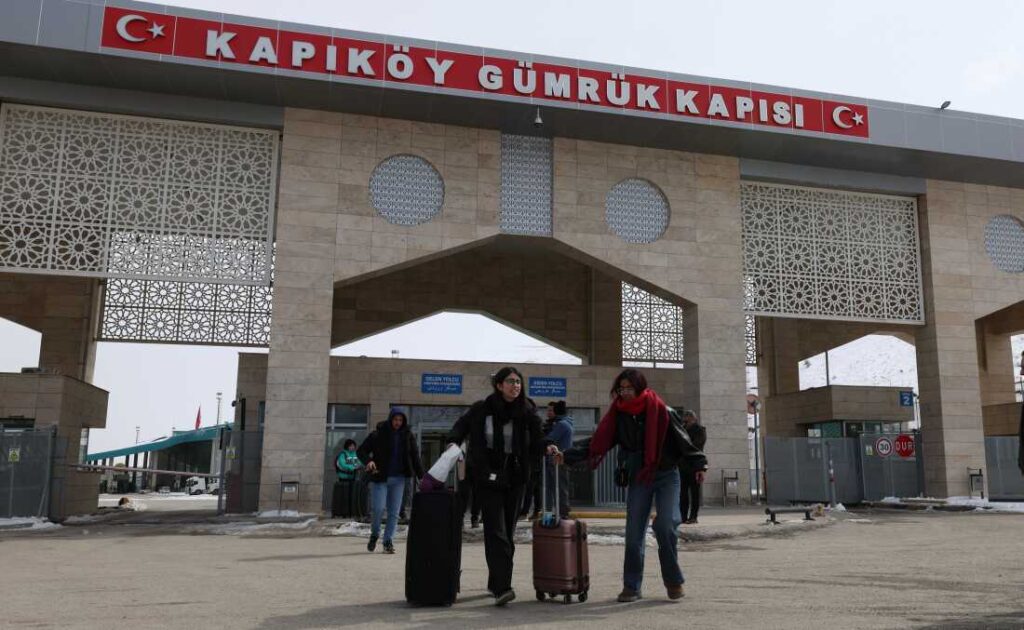
People at the Kapikoy border crossing between Turkey and Iran, in eastern Van province, Turkey, March 2.
Pavel Nemecek/AP
hide caption
toggle caption
Pavel Nemecek/AP
VAN, Turkey — Dazed by the sun and tired by more than a dozen hours of travel by bus, the woman from Tehran, Iran’s capital, crossed into eastern Turkey.
Her first stop? Somewhere with Wi-Fi.
“I only want to make a video call and go back [to Iran.] That is it,” she told NPR.
For the last month, she has been making the hours-long drive to Iran’s border with Turkey every three days in order to use the internet for a few hours to contact her son, who is studying at a university in western Turkey.
Like most Iranians interviewed for this story, she requested total anonymity because she fears arrest and her assets being seized in Iran for speaking to foreign media.
Since the beginning of the war more than a month ago, Iran’s government has blocked its citizens from accessing the global internet, leaving only a few phone lines and select, government-approved “white SIM” phone cards functioning. Now, nearly 90 million Iranians find themselves isolated from basic information about what is happening amid daily U.S. and Israeli strikes on the country.
NPR has been interviewing Iranians transiting through eastern Turkey, along the country’s border with Iran. Iranians crossing the Turkish land border — arriving by train, and speaking from Van’s many restaurants, hotels and lowkey tea shops catering to Iranian visitors — told NPR about how they are trying to skirt Iran’s internet controls.
“The only voice is the voice of the Iranian regime now, because they have cut the internet. They have shot our voices and cut our tongues,” a second Iranian woman told NPR, while traveling in eastern Turkey.
Some can afford to buy precious minutes of Wi-Fi or phone time from a black market of Starlink bandwidth and phone SIM cards, but many Iranians say the connections are glitchy, unable to load most web pages and social media sites.
And so, for Iranians with the means to travel, there is one other option for internet: to travel to another country.
“When we can access internet, we can talk for ourselves,” said the woman.
Creating internet “chokepoints”
For the last decade and a half, Iran’s government has been quietly restructuring the country’s internet infrastructure to enable the regime to shut off the internet for all but a select few people.
The preparations began after mass anti-government protests in 2009, say cybersecurity researchers and human rights advocacy groups, protests during which social media sites, especially Twitter, helped demonstrators organize.
“This is true a highly centralized architecture,” says Hesam Nourooz Pour, a researcher at the University of Copenhagen. “Unlike the global internet, which is relatively decentralized, Iran routes international traffic through a small number of the state-controlled gateways operated by the telecommunication infrastructure company. I see these gateways function as chokepoints, because nearly all incoming and outgoing international traffic passes through them.”
Iran also started creating an internal internet, called the National Information Network, or NIN, on which government-approved sites and the country’s banking and financial services could run, even when connectivity to the global internet was cut off. (Iranians still receive SMS text messages from the government since SMS is cellular network-based and not dependent on the internet, which the NIN is part of).
Authorities have also issued some phone SIM cards to government-affiliated Iranians which still can connect to the global internet, because they are exempt from a rigorous filtering system Iran created, modeled after China’s internet censorship technology.
Abbas Milani, a professor of Iranian history at Stanford University, says his friends in Iran are now paying exorbitant prices to buy just minutes of Starlink connections and so-called “white SIMs” — elite, government-approved phone cards from which some Iranians are illegally selling bytes of bandwidth.
“It is extremely dangerous even to buy [Wi-Fi] because the regime has declared that this is a counterrevolutionary activity,” Milani says.
Iranian authorities have been arresting hundreds of people for using the internet. A law enforcement officer in Yazd province, in central Iran, told Iranian media that six people had been arrested in late March for using Starlink equipment. That same month, Iranian authorities said they had arrested 466 people for using the internet to hurt national security.
Some Iranians say they have deputized friends who are traveling internationally to send messages out.
“22 days have passed since the war (and the complete internet blackout in Iran). This episode was recorded and edited in mid-February,” wrote Ershad, a popular Iranian podcast host, in a caption for a YouTube video he uploaded last month. “In order to publish [the episode], I came to my hometown of Marivan, the zero point of the border,” he continued, naming a town on Iran’s border with Iraq. From there, he says he could access Iraqi phone data networks to post his episode.
The hosts behind a second popular Persian-language podcast called Haagirvaagir, and hosted from Iran, released a long-delayed episode in late March, writing, “we are sending [the episode] out of Iran border on a memory card with difficulty and despair at the chance of it being uploaded.”
A “war crime” to shut off the internet
The internet outage has been so absolute that Iranians say they cannot receive warnings about where the next American and Israeli strikes will land. Many people have been unable to communicate with family members outside of the country to let them know they are alive.
“It is only after we have left Iran, that I have been connected and I am reading [the international news] and I am finding out which places have been hit and what has exactly happened [in Iran],” an Iranian woman vacationing for a long weekend in Turkey with her children told NPR.
Milani calls the internet blackout a war crime because it leaves tens of millions of Iranians unable to avoid Israel or the U.S. bombing them. The internet shutdown has also decimated Iranian small businesses, which used WhatsApp and Instagram to reach customers. Milani says the regime is willing to bear this cost.
“Education has been stopped. All our communication has been stopped,” said an Iranian business owner, who said he had traveled to Turkey for just two days to check his WhatsApp messages and the international news. His own business, providing online training to other small businesses, had been frozen due to the internet outage. “Nearly 80% of the businesses we worked with are going to go bankrupt, I think, in the next year … We cannot do any work if we are not connected back to internet.”
“They feel — and I think they’re right — that this is the most existential threat they have. That’s why they have gone berserk,” says Milani of the Islamic Republic of Iran. “They’re willing to pay any price, including bringing the entire global economy to a crisis, if that’s the price the world has to pay for their survival.”
Four Iranians told NPR that they were receiving regular SMS text messages from government authorities, reminding them that speaking to foreign media or leaking information to foreign agents was punishable by arrest and property confiscation.
“They cut off the internet for us, but they have their own,” one Iranian living in Tehran wrote NPR. “They cut off our money, water, electricity, and everything else for us, but they have their own [internet] and SMS [text services].”

Source link